The Big Idea
Every drop of water that falls from the sky today has been on Earth for billions of years. The water you drink this morning might once have been inside a dinosaur or part of an ancient ocean. Earth does not get new water from outer space. Instead, our planet continuously cleans and recycles water through a giant system called the water cycle.
How It Works
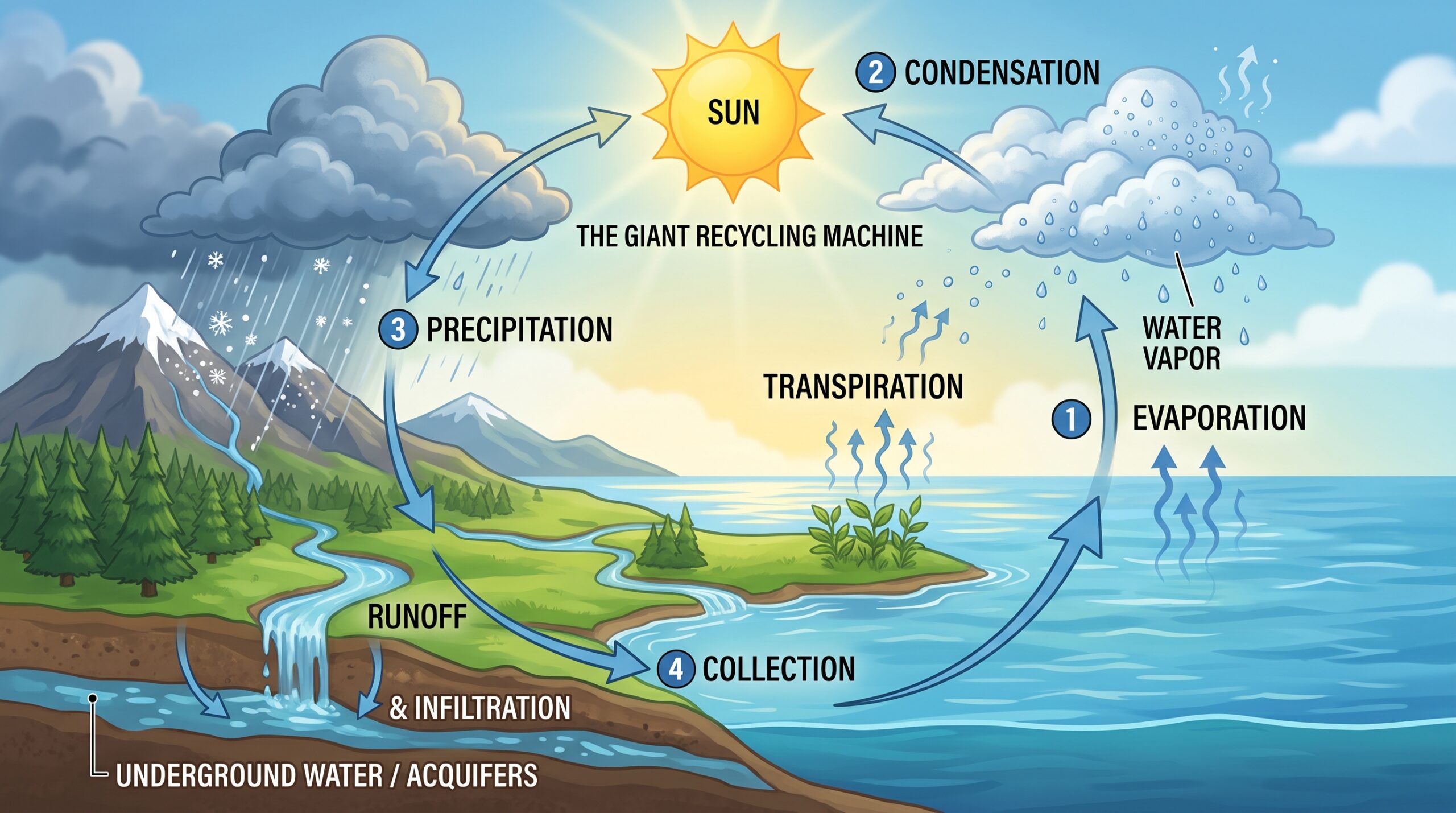
The water cycle is driven entirely by heat from the sun and moves through four continuous stages. The first stage is evaporation. When the warm sun shines down on oceans, rivers, and lakes, liquid water heats up and changes into an invisible gas called water vapor. Plants also release water vapor from their leaves through transpiration.
As this warm water vapor rises higher into the cold atmosphere, it begins the second stage: condensation. The cold air cools the vapor down, turning it back into tiny liquid droplets that gather together to form fluffy clouds. When these clouds become too heavy with moisture, the third stage happens: precipitation. Water falls back to the ground as rain, snow, hail, or sleet. Finally, during collection, the fallen water flows into rivers, fills underground reservoirs, or returns to the ocean, ready to begin again.
Why It Matters
The water cycle distributes clean freshwater across continents, watering farms, filling drinking wells, and cooling climates. Understanding how water moves helps hydrologists and civil engineers manage droughts, predict floods, and design better water systems for growing cities.
Key Vocabulary
- Evaporation: The process where liquid water turns into vapor because of heat.
- Condensation: The cooling process where water vapor turns back into liquid droplets.
- Precipitation: Any form of water, like rain or snow, that falls from clouds.